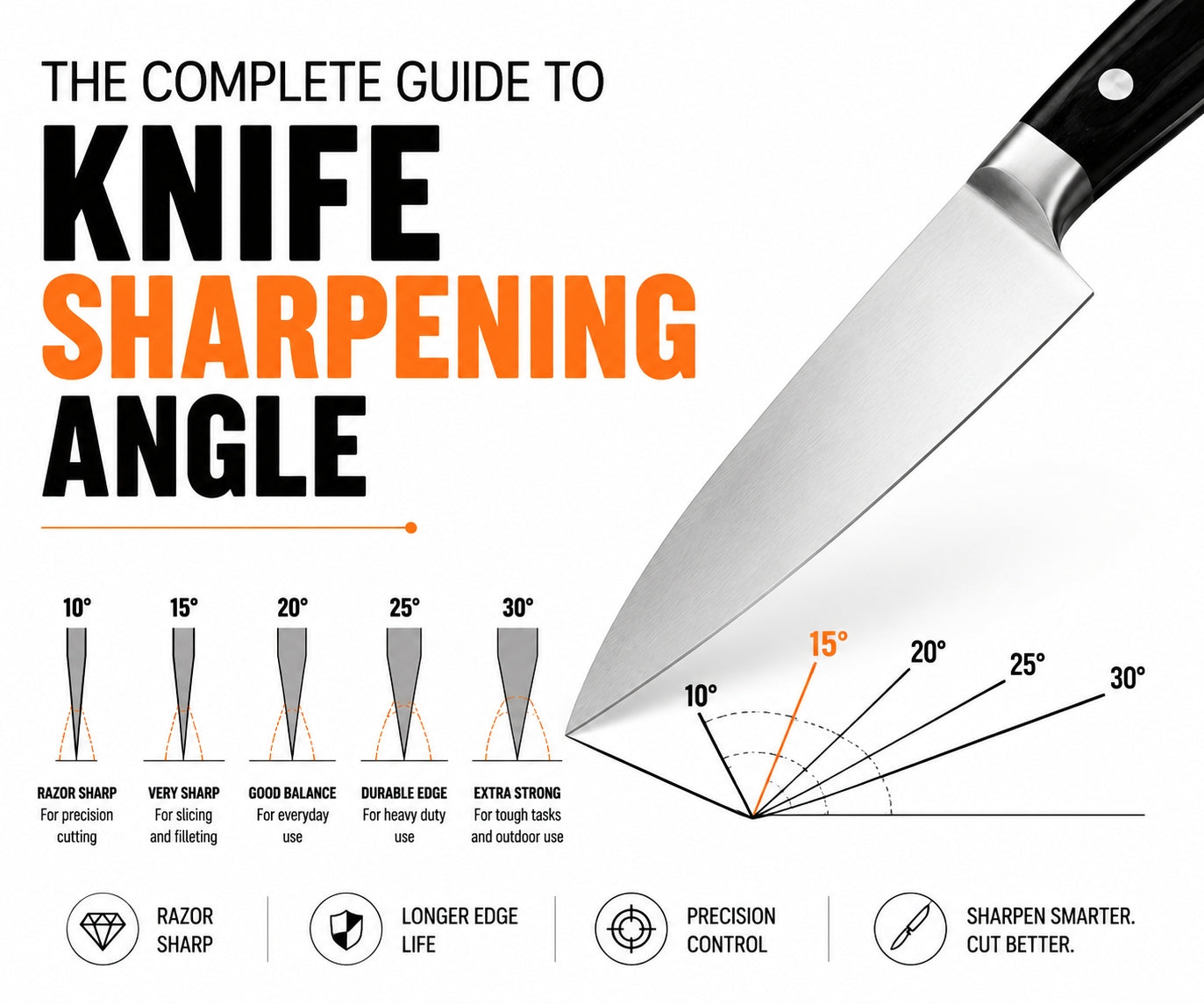
Sharpening a knife is probably the most common thing you'll do for home cooking or outdoor adventures. Have you ever tried cutting a tomato and ended up smashing it instead of slicing it cleanly? Or maybe your knives feel dull even after a few rounds of sharpening? The problem isn’t always the knife- it’s often the angle you’re sharpening it at.
Understanding knife sharpening angles is the secret to sharper, longer-lasting knives, and safer cooking. As the saying goes, sharpening the knife does not delay the woodcutting. Knowing the knife-sharpening angle before using a knife sharpener is a small but necessary step.
This guide is for anyone who cooks at home, wants their knives to perform better, and wants to stop guessing when it comes to sharpening. We’ll walk you through everything: what angles are, why they matter, how to pick the right one, and how to maintain your knives effortlessly.
Let's start with a basic concept.
What Are Knife Sharpening Angles?
A knife sharpening angle is the angle formed between the knife’s edge and the sharpening surface (stone, rod, or other tool). Think of it as how steep the blade is:
- Smaller angles = sharper, thinner edge. Perfect for delicate slicing like vegetables or fish.
- Larger angles = thicker, tougher edge. Great for chopping harder foods like squash, meat, or bones.
It’s important to understand that the sharpening angle is not the same as the total angle of the cutting edge. Most knives have a bevel on both sides, which means when you sharpen each side at, for example, 20°, the total cutting edge angle becomes 40° (20° + 20°). So, when we talk about a “sharpening angle,” we mean the angle you hold the knife to your stone for one side of the blade—not the full angle of the knife’s cutting edge.
This distinction matters because it helps you choose the right angle for the type of knife you have. For instance, Japanese knives, made from harder steel, can achieve extremely sharp edges and usually have a cutting edge angle of about 30°. That means the sharpening angle for each side is roughly 15°. In comparison, German or European knives, made from slightly softer steel, typically have a cutting edge angle of 36°–40°, so the sharpening angle per side is around 18°–20°. Knowing that the sharpening angle is roughly half of the total cutting edge angle ensures you sharpen consistently and get the performance you want—sharp where it needs to be, but durable enough for everyday use.

Why the Sharpening Angle Matters in Daily Cooking
Using the wrong angle can make your knife:
- Hard to cut with – more effort, less clean slices
- Less safe – slippery knives increase the risk of cuts
- Wear out faster – edges chip or roll if sharpened incorrectly
Getting the angle right saves time, frustration, and even potential injuries.
Choosing the Right Knife Sharpening Angle
| Knife Type | Angle (per side) | Best For |
|---|---|---|
| Japanese knives (Santoku, Gyuto) | 10°–15° | Precision slicing, fish, thin vegetables |
| European knives (Chef’s knife, Utility knife) | 15°–20° | Everyday kitchen tasks, chopping, dicing |
| Heavy-duty knives (Cleaver, meat knives) | 20°–25° | Hard vegetables, meat, bones |
Quick Tip: Smaller angles = sharp but delicate. Larger angles = strong and forgiving.

How to Determine the Right Angle
- Check your knife type. Japanese knives = smaller angles, European knives = medium, heavy-duty = larger.
- Consider what you cook most. Soft foods = smaller angles, tough foods = larger angles.
- Visual check: Hold the knife under light. Thin edge = small angle, thick edge = large angle.
- Test cut: Slice soft vegetables. Smooth slicing = correct angle.
Comparing Knife Edges and Sharpening Angle
| Knife Type | Angle | Edge Strength | Best Use |
|---|---|---|---|
| Japanese-style | 10°–15° | Very sharp, delicate | Sushi, sashimi, thin vegetables |
| European-style | 15°–20° | Balanced | Everyday chopping, slicing |
| Heavy-duty | 20°–25° | Very durable | Bones, meat, heavy chopping |

FAQs: Knife Sharpening Angle Guide
1. How can I find the correct sharpening angle for my knife?
Finding the correct knife sharpening angle begins with identifying the type of knife and its intended use. Japanese knives, such as Santoku or Gyuto, are designed for precision slicing and typically require a smaller angle of 10° to 15° per side. European knives, like German chef knives, are built for durability and general kitchen use, so an angle of 15° to 20° per side works best. Heavy-duty knives or cleavers, which cut through bones or dense foods, often need even larger angles, ranging from 20° to 25°. Understanding your knife’s purpose narrows down the ideal angle range.
After determining the appropriate angle range, you can maintain consistency through angle guides or by practicing manual sharpening techniques. Holding the knife under light helps; a uniform reflection along the edge indicates a consistent angle. Observing the knife’s cutting performance is also useful: a correctly sharpened knife glides smoothly through its intended materials without excessive force. Combining knowledge of knife type, practical testing, and consistent technique ensures the edge performs safely and efficiently.
Should I use a 15° or 20° edge?
Choosing between a 15° or 20° knife edge depends on the balance between sharpness and durability. A 15° edge is thinner and sharper, ideal for precision slicing, delicate vegetables, or fish. This angle creates a very fine cutting edge that excels in accuracy but is more fragile and may require more frequent maintenance. Using a knife with a 15° edge on hard foods or surfaces may lead to chipping or rolling of the edge.
A 20° edge, however, is more robust, providing a durable edge suitable for general-purpose kitchen tasks. It tolerates heavier use and is less likely to chip, while still being sharp enough for most cutting jobs. For home cooks or chefs seeking longevity and versatility, 20° is often more practical. Selecting the right edge angle depends on both the type of knife and the kind of cutting you perform most frequently, striking the ideal balance between precision and durability.
What happens if I sharpen at the wrong angle?
Sharpening a knife at an incorrect angle affects both performance and durability. If the angle is too steep, the blade edge becomes thick and blunt, reducing cutting efficiency and requiring more force. If the angle is too shallow, the edge becomes razor-thin and fragile, prone to chipping or rolling under pressure. Incorrect angles shorten the knife’s lifespan and compromise cutting consistency.
Using the wrong angle also impacts safety. A poorly sharpened edge can slip during cutting, increasing the risk of accidents. It may require more force to cut through ingredients, causing fatigue or mistakes. Maintaining the correct knife sharpening angle ensures a balance of sharpness, durability, and safety, allowing the knife to perform predictably and efficiently for a wide range of tasks.
What angle are Japanese knives sharpened at?
Japanese knives, including Santoku, Gyuto, and Nakiri, are sharpened at a 10°–15° per side angle, which is much sharper than most Western knives. This acute angle allows for precise slicing and fine cuts, ideal for delicate ingredients such as vegetables, fish, and thin meats. The sharper edge reduces resistance, enabling effortless slicing with minimal force.
Because Japanese knives are so thinly ground, they are more delicate and prone to chipping if used on hard surfaces or bones. Maintaining a consistent angle is critical for preserving both the knife’s performance and lifespan. Correct angles help ensure clean cuts, smooth operation, and a long-lasting edge that remains reliable for professional or home use.
What angle are German knives sharpened at?
German knives, such as those from Wüsthof or Henckels, are built for all-purpose kitchen use and durability. Typically, these knives are sharpened at a 20° per side angle, producing a strong and resilient edge that can handle a wide variety of foods. This angle ensures the knife remains sharp enough for slicing and chopping while resisting chipping and rolling under heavier use.
Some premium German knives feature slightly narrower angles around 18° to achieve a sharper edge while still maintaining robustness. German knives are designed for balance: they combine sharpness, durability, and ease of use, making them suitable for professional and home kitchens alike. Maintaining a consistent sharpening angle is key to preserving the knife’s performance and ensuring predictable cutting results over time.
How do I know if my knife is 15° or 20°?
Determining whether a knife is sharpened at 15° or 20° can be done using measurement tools or visual estimation. Angle guides can be clipped onto the knife or placed on a sharpening stone to measure the edge precisely. Without tools, observation helps: a 15° edge appears thinner and sharper, while a 20° edge looks thicker and more robust. Testing cutting performance can also indicate the angle: a 15° edge slices with minimal effort, while a 20° edge requires slightly more force but is more durable.
Understanding your knife’s angle is crucial for maintaining performance. Consistent technique ensures the edge remains functional and safe. Practicing careful observation and measurement allows for more accurate sharpening and helps avoid mistakes that could compromise the knife’s longevity or cutting efficiency.
What angle does Buck put on their knives?
Buck knives, known for outdoor and utility applications, typically feature a 20° to 25° per side angle. This wider edge is designed to withstand heavy-duty tasks such as cutting wood, rope, or meat, making the knife durable and resistant to chipping. The angle balances cutting ability with edge strength, ensuring reliability in outdoor environments where a razor-thin edge would be too fragile.
Some specialty Buck knives may be sharpened to slightly smaller angles for precise cutting tasks, but the primary design focus is durability. Sharpening to the correct angle ensures the knife maintains optimal performance for its intended use, extending its lifespan and maintaining safety during challenging outdoor tasks.
Tips for Maintaining Your Knife Edge
- Use an angle guide for consistency
- Hone regularly to keep edges aligned
- Cut on wood or plastic boards, not glass or stone
- Sharpen only as needed to preserve the edge
Understanding Grit
| Grit | Purpose | Best Use |
|---|---|---|
| 200–400 | Coarse | Repair nicks, reshape edge |
| 800–1000 | Medium | General sharpening |
| 2000–3000 | Fine | Smooth, precise edge |
| 4000–6000 | Very fine | Polishing, professional slicing |
| 8000+ | Ultra fine | Mirror finish, precision work |
Final Words
Choosing the right knife sharpening angle isn’t complicated. Know your knife, consider what you cook, and maintain a consistent angle. With the right approach, sharpening becomes easier, safer, and more effective. Smooth slicing, longer-lasting edges, and happier cooking are just a few simple steps away.