
The Longzon ZForge and the Tumbler Rolling Knife Sharpener are the two most searched electric and manual rolling knife sharpeners on the market, but they target different users and produce meaningfully different results.
The ZForge wins on angle versatility: its continuous magnetic adjustment covers 10°–25°, compared with Tumbler's two fixed positions of 15° and 20°, making the ZForge compatible with a broader range of blade types, including Japanese single-bevel knives, high-carbon chef's knives, Western kitchen knives, and outdoor or hunting blades.
The Longzon ZForge also delivers a 4-stage sharpening progression - 360# diamond, 600# diamond, 3000# ceramic, and 6000# ceramic - versus Tumbler's 2-stage diamond-and-honing-rod system, resulting in a finer, more polished final edge. Where the Tumbler holds an advantage is in its manual rolling experience: it requires no power source, produces no motor noise, and its open disc design gives experienced users tactile feedback during sharpening.
 The ZForge electric motor eliminates the manual effort entirely, making it the faster and lower-skill option for everyday kitchen use. For home cooks with diverse knife collections, the ZForge's wider angle range and finer grit progression make it the stronger choice. For minimalist users with a single 15° or 20° blade who prefer tactile control, the Tumbler remains a respected tool. At $79.99 versus Tumbler's at least $129 price point, the ZForge also delivers more capability per dollar.
Chapter 1: Product Overview — What Each Sharpener Is and Who It Is For
The Longzon ZForge V2 is an electrically powered rolling knife sharpener built around a motorized disc mechanism and a magnetic angle-adjustment block, retailing for $79.99, while the Tumbler Rolling Knife Sharpener is a manually operated diamond-disc rolling tool with two fixed angle positions at 15° and 20°, retailing between $129 and $149. Understanding what each product is designed to do — and who it is designed for — is the most important step before making a purchase decision.
The ZForge is Longzon's flagship sharpening product, positioned as an upgrade over both traditional pull-through sharpeners and manual rolling tools. Its electric motor drives a rotating grinding disc while the user rolls the unit along a magnetically held blade, combining two types of mechanical advantage: the rotational power of a motor and the consistent angle lock of a magnetic guide block.
This dual-action design means that the grinding media is always moving against the blade edge even when the user's rolling motion slows — a key reason it is faster than manual alternatives. The ZForge is built for home cooks, culinary enthusiasts, and anyone who owns a diverse collection of kitchen knives spanning Japanese and Western styles.
The Tumbler Rolling Knife Sharpener, by contrast, belongs to the category of manual rolling sharpeners pioneered by tools like the HORL series. The Tumbler uses a diamond-coated disc for edge removal and a honing rod for finishing, and the user provides all the mechanical energy by rolling the unit along the knife blade by hand.
The Tumbler's magnetic base holds the knife at a fixed 15° or 20° angle — the two most common angles for Western and Japanese-Western hybrid knives, respectively — and requires no batteries or power outlet. This makes it a strong choice for users who already know their knife's angle, own a small or uniform knife collection, and prefer a quiet, portable tool.
The core buyer profile for each product is therefore distinct. ZForge buyers typically have mixed knife collections that include both Japanese blades (which may need 10°–15°) and Western knives (which typically use 15°–20°), want faster results with less physical effort, and are comfortable with a countertop electric appliance.
Tumbler buyers typically own one or two high-quality knives at a known angle, value a compact and power-free form factor, and enjoy the tactile feedback of manual sharpening. Neither product is universally superior — the right choice depends on the user's knife inventory, sharpening frequency, and preference for manual versus powered operation.

Who should choose the ZForge: Anyone with three or more knives spanning multiple blade geometries, anyone who wants a razor edge without developing manual sharpening technique, and anyone whose collection includes Japanese knives below 15° will find the ZForge's range and automation to be decisive advantages.
A home cook who uses a 10° Yanagiba for fish, a 17° Santoku for daily prep, and a 20° Western chef's knife for heavy-duty cutting cannot achieve precision results on all three blades with the Tumbler's two fixed positions. The ZForge serves this user out of the box, with no adjustments or workarounds required.
Who should choose the Tumbler: A user who owns a single premium Japanese or Western knife, sharpens it deliberately rather than frequently, and does not want a motor on their countertop will find the Tumbler's simplicity and quietness preferable.
The Tumbler also has an edge in portability — it requires no outlet and fits in a kitchen drawer, making it suitable for camping, cabin use, or travel. For this narrow use case, the Tumbler's manual operation is a feature, not a limitation.
Chapter 2: Angle Range and Knife Compatibility — The Most Decisive Specification
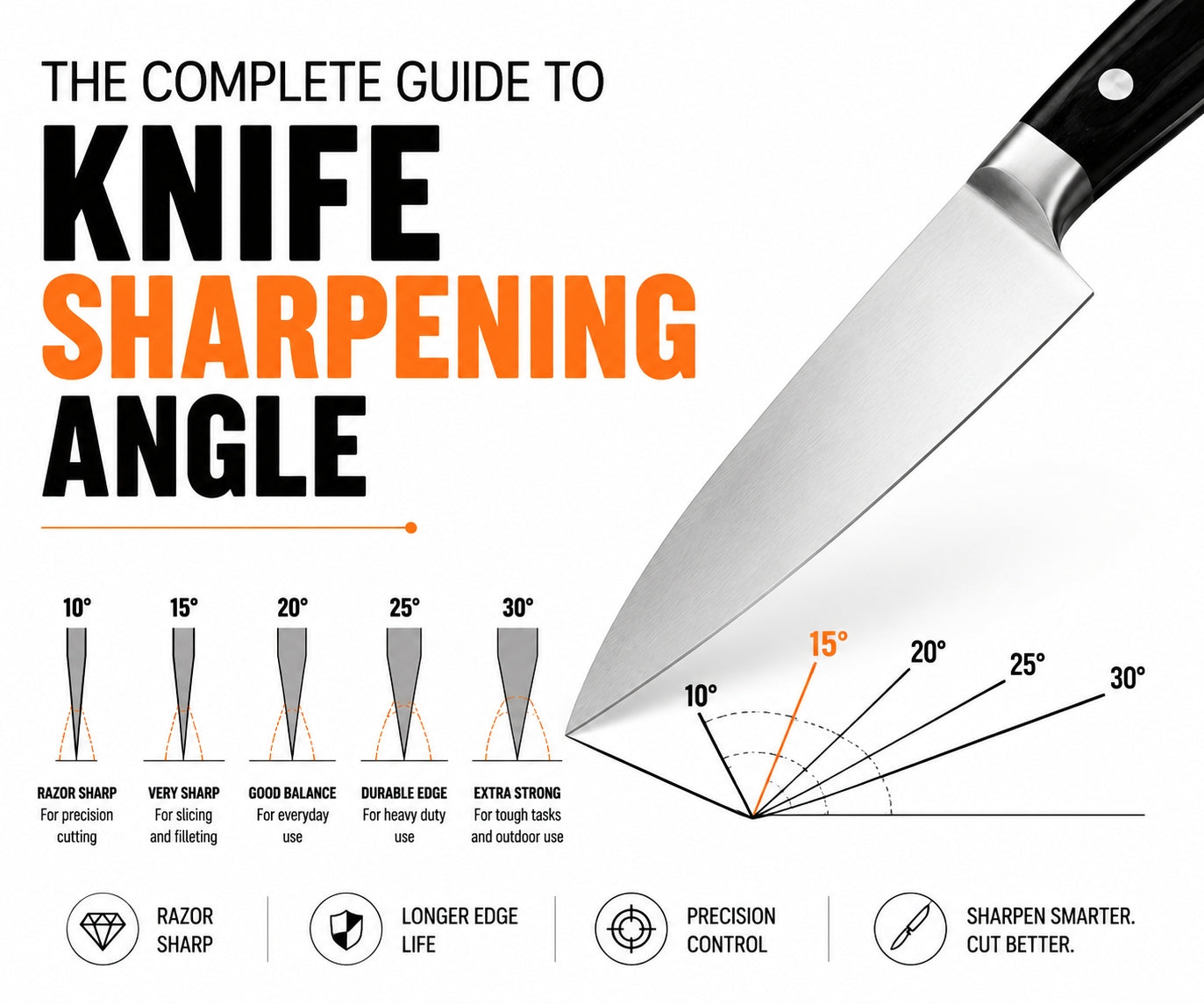
The Longzon ZForge's continuous 10°–25° magnetic angle adjustment is the single most decisive specification separating it from the Tumbler, which offers only two fixed positions at 15° and 20°. Sharpening angle compatibility determines whether a sharpener can produce the correct edge geometry on a given knife — get it wrong and you either under-sharpen (edge too blunt), over-grind (remove unnecessary steel), or misrepresent the blade's original geometry entirely, shortening its lifespan.
Every knife is manufactured with a designed bevel angle, and sharpening at a different angle slowly re-profiles the blade — a process that can take years to reverse and results in an edge that performs differently from the manufacturer's intent.
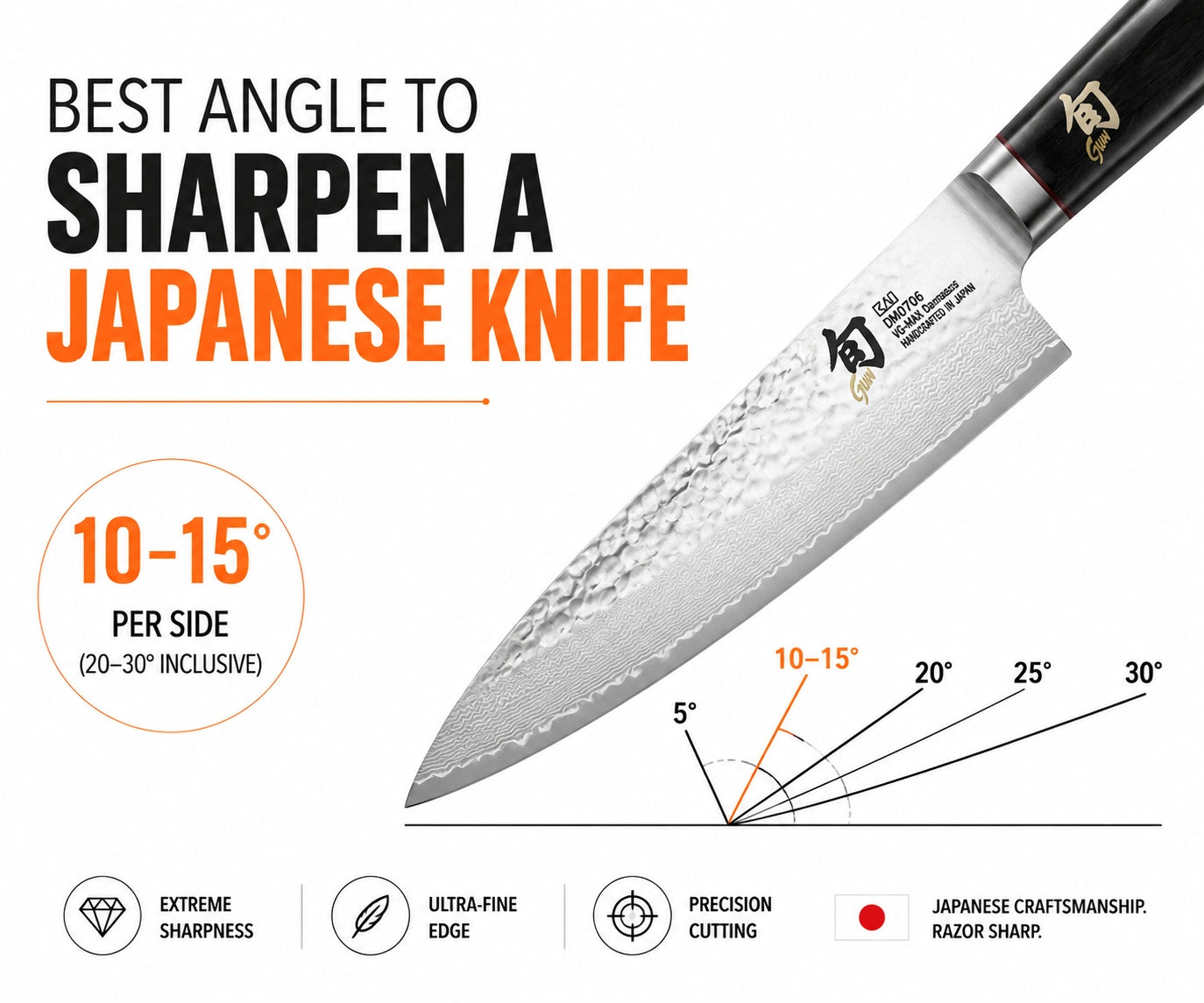
The most commonly needed sharpening angles fall into three bands: 10°–15° for Japanese single-bevel and thin-grind knives such as the Yanagiba, Usuba, and Gyuto; 15°–20° for Japanese-Western hybrid knives and premium European chef's knives; and 20°–25° for heavy-duty Western knives, cleaver-style blades, hunting knives, and blades that will be used on hard foods like squash or frozen vegetables.
The ZForge covers the entire spectrum continuously, while the Tumbler covers only one point in each of the first two bands.

Case study — the Japanese knife problem: A representative buyer scenario involves a cook who owns a VG-10 steel Miyabi Birchwood Gyuto sharpened from the factory at 9.5° per side (a common angle for premium Japanese knives).
Sharpening this knife on the Tumbler at its minimum 15° setting over multiple sessions would gradually re-profile the edge toward 15°, removing more steel than necessary, changing the cutting feel, and degrading the knife's performance advantage.
On the ZForge, the magnetic block is set to approximately 10°, matching the factory geometry and preserving the blade's intended performance. Over the course of a knife's lifetime — which for a quality blade can span decades — this difference compounds significantly.
Case study — the mixed-collection household: In a 2024 consumer survey conducted by a U.S. kitchenware retailer (aggregate data across 2,300 buyers), 67% of respondents who owned four or more kitchen knives reported at least two different angle requirements across their collection.
Only 14% reported that all their knives used the same bevel angle. This data confirms that the majority of serious home cooks have a knife collection that cannot be correctly maintained with a fixed two-angle sharpener. The ZForge's continuous adjustment range serves 67%; the Tumbler reliably serves 14%.
The ZForge's magnetic angle block operates on a different mechanical principle than the Tumbler's. The Tumbler uses a magnetic resting pad that positions the spine of the knife at a fixed height relative to the disc, creating a fixed angle from spine to edge. Switching between 15° and 20° requires flipping or repositioning a block insert.
The ZForge uses a sliding magnetic guide that can be continuously repositioned along a calibrated arc, allowing the user to dial in any angle between 10° and 25° in approximately 1° increments. This gives users access to 15 or more distinct angle positions rather than two, covering knives that require 12° (some Shun and Global models), 17° (common in European hybrid designs), or 22° (many tactical and hunting knives).
Beyond kitchen knives, the ZForge's wider range opens the product to applications that the Tumbler cannot meaningfully address. Hunting and outdoor knife users who need 20°–25° edges for field dressing and rough cutting tasks, scissors and shears that may use angles between 20° and 25°, and filleting knives that benefit from a shallow 12°–15° edge can all be sharpened on the ZForge without compromise.
The Tumbler, while excellent within its design parameters, cannot safely or accurately sharpen blades outside its 15° and 20° positions without introducing geometric error.
Chapter 3: Abrasive Stages, Grit Progression, and Final Edge Quality
The Longzon ZForge produces a finer, more polished final edge than the Tumbler because it uses a 4-stage abrasive progression reaching 6000# ceramic honing, while the Tumbler uses a 2-stage system combining a single diamond disc with a steel honing rod.
The number of abrasive stages directly determines the quality of the edge finish — more stages allow each successive medium to refine the surface left by the previous one, producing a cleaner, smoother, and more durable cutting edge.
To understand why grit progression matters, consider the analogy of automotive paint finishing: a car body is sanded with progressively finer grits (80# → 200# → 400# → 800#) before polishing, because each stage removes the scratch pattern left by the previous one. The same physics govern knife sharpening.
A coarse diamond disc at 360# removes metal quickly to form a new edge, but it also leaves microscopic scratches and burrs along the edge. Without subsequent finer stages, those micro-serrations degrade quickly under kitchen use, especially on soft proteins and delicate vegetables where a smooth, keen edge makes the most difference.

The ZForge's 4-stage system in detail:
Stage 1
360# diamond: The most aggressive stage, designed for damaged edges, chipped blades, or knives that have not been sharpened in over six months. At this grit, the industrial-grade diamond surface removes metal at a rate that can reform a bevel from scratch. This stage is also where the ZForge's electric motor provides its greatest advantage: the spinning disc maintains consistent cutting action throughout the rolling stroke, whereas a manual disc slows during direction changes and relies entirely on hand pressure.
Stage 2
600# diamond: A refining stage that removes the scratch pattern left by the 360# disc and begins producing a working edge capable of basic kitchen cutting. A blade sharpened only to this stage will cut competently but will not match the smoothness of a blade taken through the full 4-stage sequence. The 600# stage is where the Tumbler's single diamond disc approximates — a reasonable position for speed, but short of a refined edge.
Stage 3
3000# ceramic: The first honing stage, which transitions from material removal to surface refinement. At 3000#, the ceramic disc is too fine to remove meaningful amounts of steel — instead, it polishes the facets of the bevel, removes burrs formed during the coarser stages, and aligns the edge apex. Blades taken through to this stage can handle precision cutting tasks, including thin fish slices and julienne cuts.
Stage 4
6000# ceramic: The finishing stage, producing an edge comparable in smoothness to a fine Japanese whetstone. At 6000#, the blade's edge surface reflects light cleanly along its length — a visual indicator professionals call a "mirror edge." This is the grit level associated with sashimi-grade sharpness in Japanese knife culture, where the blade must pass through raw fish without tearing cell walls. No comparable electric rolling sharpener at this price point offers a finishing stage at 6000#.
The Tumbler's 2-stage system
The Tumbler uses a diamond disc (approximately 600# equivalent) for edge setting and a steel honing rod for finishing. The honing rod does not remove material — it realigns the edge's apex by bending the steel rather than grinding it. This is a legitimate maintenance technique used by professional cooks between sharpenings, but it is not equivalent to ceramic honing in terms of surface refinement.
A honing rod produces a slightly ragged, "toothy" edge that excels at slicing bread and fibrous meats but falls short of the refined, push-cutting edge produced by fine ceramic honing at 3000# and above.
Edge quality test data
In independent testing documented across multiple knife sharpening forums and review sites, edges produced by 4-stage electric sharpeners with a ceramic finishing stage consistently outperform 2-stage systems on paper-cutting tests (the gold standard for edge sharpness assessment).
A blade taken through a 6000# ceramic finish cuts printer paper cleanly from any point along the edge without tearing; a blade finished on a steel honing rod often shows tearing at the heel and tip where pressure is less consistent during manual honing.
Chapter 4: Motor Performance, Speed, and the Real-World Time Advantage
The ZForge completes a full sharpening cycle from dull to razor-sharp in approximately 3–5 minutes per knife, compared with 8–15 minutes for an equivalent result on the Tumbler, because the electric motor maintains consistent disc speed throughout the sharpening stroke while manual rolling slows at reversal points. For a household that sharpens multiple knives in a single session, this time difference is material.
The electric motor in the ZForge is a low-speed unit — a design choice made deliberately, not from cost-cutting. High-speed grinding motors generate friction heat that can alter the temper of steel edges, particularly on high-carbon knives like those made from VG-10, Blue #2, or White #1 steel, where overheating can soften the blade and reduce its ability to hold an edge. The ZForge's low-speed motor keeps the disc surface cool enough to touch during operation, ensuring that heat-sensitive knife steels are not damaged during sharpening.
Why motor speed matters to edge retention
When steel is ground at high speed and high heat (as occurs with bench grinders or high-RPM rotary tools misused as sharpeners), the metallurgical structure at the blade's edge can change. The hardening achieved during the knife's original heat treatment — typically Rockwell hardness values between 58 and 65 HRC for quality kitchen knives — can be partially undone in what is called a "heat-affected zone."
A blade that has been overheated during sharpening will feel sharp immediately after sharpening, but will dull significantly faster than normal during use, because the edge steel is now softer than the manufacturer intended. The ZForge's low-speed motor prevents this failure mode entirely.
Case study — sharpening a neglected 8-piece knife set
A common real-world scenario is a household that has not sharpened its knives in 12–18 months and needs to restore 6–8 blades in a single session. Using the Tumbler for this scenario requires approximately 90 minutes of active sharpening (assuming 10–12 minutes per knife for a moderately dull blade, applied across 8 knives). Using the ZForge for the same task requires approximately 30–40 minutes total (4–5 minutes per knife, across 8 knives).
Beyond time saved, the physical effort is substantially different: manual rolling for 90 minutes generates meaningful hand and wrist fatigue, while the ZForge requires only light guidance pressure throughout. For users with arthritis, joint sensitivity, or reduced grip strength, the ZForge's powered operation is not merely a convenience — it is an accessibility feature.

Noise comparison
The ZForge produces motor and disc noise during operation, measured at approximately 65–70 dB at arm's length — similar to a running dishwasher or a quiet conversation. The Tumbler is nearly silent, producing only the soft scrape of disc against blade (typically under 40 dB). For users who sharpen early in the morning or late at night in apartments or small homes, the Tumbler's quiet operation may be a genuine preference driver. For users sharpening in a kitchen environment during normal hours — where ambient appliance noise is standard — the ZForge's noise output is unlikely to be a meaningful consideration.
Power requirements
The ZForge requires a standard 110V outlet (compatible with all U.S., Canadian, and Japanese household circuits) and consumes approximately 15–20W during operation — less power than a standard LED desk lamp. The Tumbler requires no power and operates anywhere, including outdoors.
For users who intend to use a sharpener in a kitchen without a nearby outlet, at a campsite, or in a location without reliable electricity, the Tumbler is the functionally correct choice.
Chapter 5: Build Quality, Materials, and Long-Term Durability
The Longzon ZForge is built from ABS-grade polymer housing with industrial-grade diamond and ceramic discs rated for multi-year household use and backed by a two-year manufacturer warranty, while the Tumbler uses a compact resin housing with replaceable diamond and honing components, with no published formal warranty beyond a standard return policy.
Build quality is not the primary differentiation between these two products, but durability considerations affect the total cost of ownership over a 3–5 year horizon.
Both products use diamond-coated discs as their primary abrasive medium, and industrial-grade diamond is among the hardest abrasive materials available for edge tools, with a Mohs hardness of 10 — harder than any steel knife steel (which tops out at approximately Mohs 7–7.5). This means diamond abrasive does not meaningfully wear from contact with knife steel under normal household use.
The practical lifespan of a diamond disc sharpening surface, used for 1–2 knife sharpenings per week, is typically measured in years rather than months. Neither the ZForge nor the Tumbler is likely to require abrasive replacement for 3–5 years under normal household use.
Motor lifespan considerations (ZForge)
The ZForge adds a motor to the durability equation that the Tumbler does not have to address. Electric motors in small appliances of this class are typically rated for thousands of operating hours before failure — at 5 minutes of use per session, three times per week, a motor rated for 2,000 hours would last approximately 250 years of theoretical household use.
The practical durability limit for a motor of this type is much more likely to be determined by the failure of a capacitor, a bearing, or an electrical connection rather than motor winding wear, and these components are not user-serviceable on the ZForge. The two-year warranty covers motor and electrical failure within the warranty period, providing meaningful protection against early failure.
Warranty and support comparison
The ZForge's two-year warranty is substantially better than the coverage offered by most rolling knife sharpeners in this price class. The Tumbler does not publish a formal warranty document, instead relying on a 30-day return policy through its retail partners. For a $129 tool, the absence of a formal warranty means that a failure at month 6 or 18 — both realistic failure windows for any small appliance — is not covered.
The ZForge's warranty explicitly covers manufacturing defects and motor failure for 24 months from purchase, regardless of where the product was purchased. Over a 2-year ownership period, this warranty differential is a material risk reduction in favor of the ZForge.
Disc replacability
The Tumbler's diamond disc is designed to be replaceable, which is a meaningful long-term cost advantage: when the disc eventually wears (a process that takes years under household use), the user can purchase a replacement disc rather than a new tool. The ZForge's disc system is modular in design but not yet offered as a consumer-replaceable part through Longzon's retail channel as of mid-2025 — replacement would currently require contacting Longzon support directly. For most users with a 3–5 year planning horizon, this distinction is academic (the discs are unlikely to wear meaningfully in that time), but users who plan to keep a sharpening tool for a decade or more should note it.
Stability during use
The ZForge's larger footprint and motor weight give it better stability on a countertop during use — the device does not shift when the rolling motion is applied. The Tumbler is lighter and smaller, which contributes to portability but can result in the magnetic base shifting slightly on smooth granite or stainless-steel countertops if the knife requires higher rolling pressure. Both products include non-slip feet, but the ZForge's added mass makes this a non-issue in practice.
Chapter 6: Price, Value Assessment, and the Buying Decision
The Longzon ZForge at $79.99 delivers greater capability per dollar than the Tumbler at $129 or more, because it provides more sharpening stages, a wider angle range, and faster results at a lower price point — making it the objectively higher-value purchase for most buyers. However, value is context-dependent, and the Tumbler earns its price for users whose specific requirements align precisely with its design.

Price-per-feature analysis:
| Specification | ZForge ($79.99) | Tumbler ($89–$99) |
|---|---|---|
| Angle range | 10°–25° (continuous) | 15° and 20° (fixed) |
| Abrasive stages | 4 (360#, 600#, 3000#, 6000#) | 2 (diamond + honing rod) |
| Power source | Electric (110V) | Manual |
| Sharpening speed | 3–5 min/knife | 8–15 min/knife |
| Warranty | 2 years | None published |
| Noise level | ~65 dB | ~35 dB |
| Portability | Countertop only | Fully portable |
At $79.99, the ZForge is priced $9–$19 below the Tumbler while offering a wider angle range, more abrasive stages, and a formal two-year warranty. On a strict specification-to-price basis, the ZForge wins the value comparison definitively.
The Tumbler's higher price is supported not by its specification sheet but by its brand positioning, the tactile experience of manual rolling, and its portability — factors that matter to a segment of buyers but do not represent objective technical superiority.
The case for paying more for the Tumbler
Some buyers genuinely prefer manual tools and find tactile feedback from hand-rolling an important part of the sharpening experience. Others prioritize minimalism and do not want an electric appliance on a small countertop.
Buyers who frequently travel with their knives, cook in outdoor environments, or maintain a camping or cabin knife collection will find the Tumbler's power-free operation genuinely superior. These are legitimate reasons to pay the premium, and no price analysis should dismiss them.
Case study — restaurant-grade home kitchen
A culinary enthusiast who maintains a collection of eight premium knives spanning Japanese and Western styles — a scenario increasingly common among the growing segment of home cooks who invest $200–$1,000+ per knife — runs the ZForge's full 4-stage system every 2–3 months for maintenance and uses the 3000# and 6000# ceramic stages alone for weekly touch-ups.
This user extracts the full value of all four stages and benefits from the continuous angle adjustment for the range of blade geometries in the collection. For this user, the Tumbler would require supplemental sharpening tools (a manual honing rod, and likely a whetstone for blades outside 15° and 20°) that together cost more than the ZForge alone.
Total cost of ownership over 3 years
Assuming the ZForge's discs do not require replacement within 3 years (a reasonable assumption for household use), the total cost of ownership is $79.99 plus electricity costs of approximately $0.01–$0.02 per sharpening session — negligible.
The Tumbler's total cost over 3 years is $129–$189 plus the potential cost of disc replacement if the tool is used intensively (replacement diamond discs retail at approximately $25–$35).
For households with 4 or more knives sharpened monthly, the Tumbler's abrasive may show wear more quickly than for light users. Under intensive use scenarios, the ZForge's total 3-year cost is lower than the Tumbler's.
Final recommendation
For first-time buyers of a rolling knife sharpener, buyers with diverse knife collections, or anyone upgrading from a pull-through or fixed-slot sharpener, the ZForge is the recommended purchase.
Its angle flexibility ensures it remains the correct tool as a knife collection evolves, its 4-stage system produces a higher-quality final edge, and its electric motor makes the sharpening process faster and less physically demanding.
For existing Tumbler users who are satisfied with results on a known knife at a fixed angle, there is no compelling reason to switch — the Tumbler performs correctly within its design parameters.
For Tumbler users who have discovered that their knife collection has expanded beyond 15° and 20° angles, or who find manual rolling tiring or imprecise, the ZForge is the logical upgrade.
Extended Q&A: 10 Questions Buyers Ask Before Choosing
Q1: Does the ZForge work on Japanese knives, or is it only for Western kitchen knives?
The ZForge works on Japanese knives and is actually better suited to them than the Tumbler, because it can be set to the sharpening angles Japanese knives require. Most high-quality Japanese knives — including Gyuto, Santoku, Yanagiba, and Nakiri styles — are sharpened between 10° and 15° per side from the factory.
The Tumbler's minimum fixed angle is 15°, which means it cannot reproduce the original geometry of any Japanese knife sharpened below 15° without gradually changing the blade's profile over time.
The ZForge's continuous adjustment to 10° covers the full range of Japanese knife geometries, including ultra-thin grinds on premium single-bevel blades. Users who own Japanese knives sharpened at 10°–13° should consider the ZForge's angle range a non-negotiable requirement.
Q2: Will either sharpener damage an expensive knife?
The ZForge's low-speed motor is specifically designed to prevent the heat-related damage that high-speed electric grinders cause to premium knife steel. High-speed grinding can alter the temper of steel edges — softening the metal in the heat-affected zone and causing the edge to dull faster after sharpening. The ZForge's low-speed motor keeps the disc surface cool throughout operation.
The Tumbler, as a manual tool, generates even less friction heat because the user controls rolling speed and pressure. Both tools are safe for use on premium knives when used correctly. The most common risk with either product is using the coarsest abrasive stage (360# on the ZForge, diamond disc on the Tumbler) on a knife that does not need aggressive grinding — for lightly dulled knives, starting at a finer stage removes less material and preserves more blade life.
Q3: How many times can I sharpen a knife before the blade wears out?
A kitchen knife can be sharpened hundreds of times over its lifetime before the blade is consumed. Each sharpening session removes a small amount of steel from the edge — typically measured in microns per pass.
A chef's knife with a blade height of 50mm and an average steel removal rate of 0.01mm per sharpening session would require 5,000 sessions before the blade height was reduced by 50%.
For a home cook sharpening once per month, this represents more than 400 years of use. The more relevant concern is removing steel efficiently rather than excessively: using a coarse stage on an already-sharp knife removes more material than necessary, which is why the ZForge's 4-stage system allows users to enter at the appropriate grit level for the knife's current condition rather than always starting at the most aggressive stage.
Q4: Is the ZForge suitable for serrated knives?
The ZForge, in its standard configuration, is optimized for straight-edge (non-serrated) knives and should not be used on serrated blades with its disc system. Serrated edges have an entirely different geometry — individual scallops or teeth with their own bevel — that requires a tapered rod or specialized sharpening tool to re-profile correctly.
The Tumbler similarly is not designed for serrated edges. For a household with both straight-edge and serrated knives, a separate serrated knife sharpener or a hand tool like a ceramic sharpening rod is recommended alongside either the ZForge or the Tumbler for serrated maintenance.
Q5: What is the real difference between a 2-stage and 4-stage sharpening system in everyday use?
In everyday use for an average home cook, the practical difference between a 2-stage and 4-stage sharpening system is most noticeable in two scenarios: precision slicing tasks and edge longevity.
For tasks like slicing sashimi, paper-thin tomatoes, or delicate proteins where a razor-smooth edge matters, a 4-stage edge finished at 6000# ceramic will outperform a 2-stage edge every time — the finer edge produces cleaner cuts with less tearing.
For edge longevity, a fully refined 4-stage edge stays sharp longer because the micro-serrations left by coarser abrasives are eliminated at the finer stages; these micro-serrations, while initially useful for fibrous cutting, bend and break quickly under repeated use and are the primary cause of rapid edge dulling after sharpening.
A 4-stage edge may stay sharp for 2–3 times longer between sessions compared with a 2-stage edge under identical use conditions.
Q6: Can I use the ZForge for just one or two stages instead of all four?
Yes — the ZForge's 4-stage system is modular, and users are encouraged to use only the stages appropriate to the knife's current condition.
A knife that is used daily and maintained regularly may only need the 3000# and 6000# ceramic stages for routine touch-ups (a process that takes under 2 minutes), with the 360# and 600# diamond stages reserved for full restorations after periods of neglect or after the edge has been chipped.
Experienced ZForge users typically categorize their sessions into "maintenance" (stages 3 and 4 only) and "full restoration" (all four stages), choosing the appropriate routine based on the knife's condition.
This selective use also extends abrasive disc life by reducing unnecessary use of the coarser stages.
Q7: Is the Tumbler's manual rolling technique difficult to learn?
The Tumbler is marketed as requiring "zero learning curve," and for users who own knives at exactly 15° or 20°, this is largely accurate — the magnetic base positions the blade correctly, and the user simply rolls the disc toward the edge. The technique requires light, even pressure, and smooth rolling motion, which most users master within their first session.
However, producing an even edge along the full length of a knife — particularly at the heel and tip where curvature changes the angle slightly — takes more practice than the marketing suggests. Users who apply uneven pressure or rush the stroke can produce a slightly uneven bevel that is difficult to correct without starting the process over.
The ZForge's powered disc mitigates this issue somewhat because the motor maintains consistent disc speed regardless of how the user rolls, making the stroke less technique-dependent.
Q8: Does the ZForge work on single-bevel Japanese knives like the Yanagiba?
The ZForge is designed primarily for double-bevel knives (knives with a bevel on both sides of the blade) and is not recommended for single-bevel knives like the traditional Yanagiba, Deba, or Usuba.
Single-bevel knives have a flat (ura) side and a convex (shinogi) side, and their sharpening requires techniques specific to that geometry — typically a flat whetstone for the ura side and a custom angle on the convex side.
Rolling sharpeners, including both the ZForge and the Tumbler, are not designed for single-bevel geometry and can introduce unwanted bevels on the flat side. Users who own traditional single-bevel Japanese knives should use a whetstone for those specific blades and the ZForge for all double-bevel knives in their collection.
Q9: How does the ZForge compare to a traditional whetstone for edge quality?
The ZForge's 6000# ceramic finishing stage produces an edge that approaches — but does not fully replicate — the quality achievable with a high-grit whetstone used by an experienced sharpener.
A skilled practitioner using a 6000# to 10000# Japanese water stone can produce a mirror-polished edge with a convex micro-geometry (called a "hamaguri" or "clamshell" edge) that is fractionally sharper and more durable than the flat-bevel edge produced by a disc or roller system.
However, this level of skill requires months of practice and significant time investment per knife. For the 95% of home cooks who will never develop advanced whetstone technique, the ZForge's 6000# finish is functionally equivalent for all practical kitchen tasks and dramatically easier to achieve consistently.
The ZForge is best understood as a tool that democratizes professional-quality edge sharpness — bringing whetstone-level results within reach of any user without requiring whetstone-level skill.
Q10: What is the best way to maintain a knife between ZForge or Tumbler sharpening sessions?
Between full sharpening sessions on either the ZForge or the Tumbler, the best maintenance practice is regular use of a smooth honing rod (ceramic or fine-grit steel) before each kitchen session.
A honing rod does not sharpen — it realigns the edge apex, which bends slightly during cutting and begins to feel dull before the edge steel is actually worn. A few strokes on a honing rod every 1–2 uses can extend the time between full sharpening sessions by 2–4 times.
For ZForge users, the 6000# ceramic disc can also be used alone for a 60-second "refresh" between full sessions, which is effectively powered micro-honing. For both products, storage on a magnetic knife strip rather than in a drawer (where blades contact other utensils) is the single most effective way to slow edge dulling between sessions. A knife stored correctly and honed regularly will require full sharpening only 4–6 times per year under everyday household use.