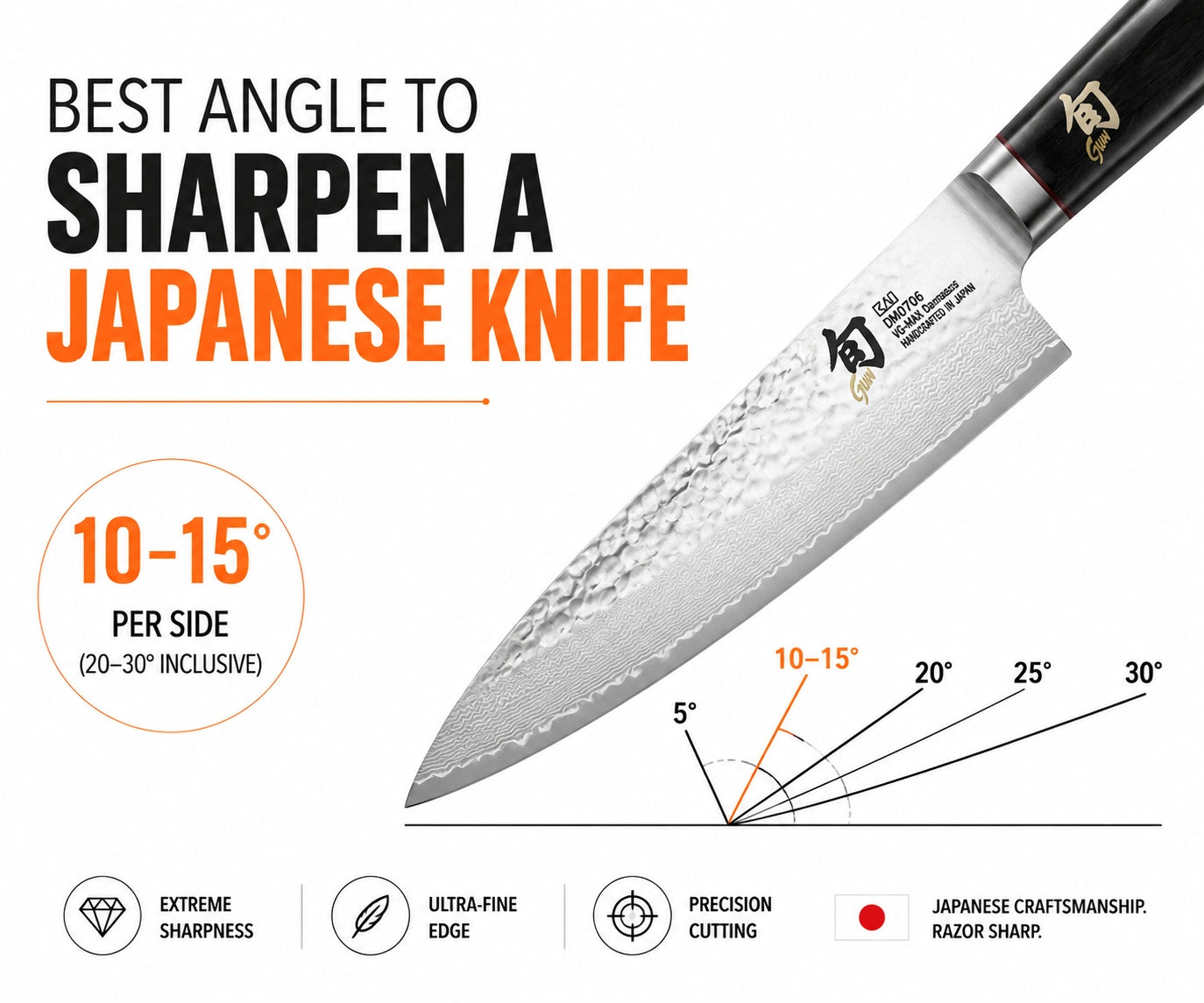

Quick Answer
The best angle to sharpen most German knives is between 14 and 17 degrees per side, with 14–15 degrees being the modern factory standard and 17–20 degrees being the correct setting for older or vintage German blades. Wüsthof's current Precision Edge Technology (PEtec) line is ground at 14 degrees per side (28 degrees total), while Zwilling's standard Western-style knives are sharpened at 15 degrees per side.
Older German knives made before roughly the mid-2000s, including earlier Wüsthof and Zwilling lines, were typically ground closer to 19–20 degrees per side using a convex edge, so “15 vs. 20 degrees” is not a contradiction — both are correct depending on the knife's age and line. German Asian-style knives within these same brands, such as Wüsthof Nakiris or Zwilling Santokus, drop to 9–12 degrees per side.
For a single all-purpose number that works safely across most German and Western kitchen knives without knowing the exact brand or year, 17 degrees per side is the most reliable default. The angle should always be adjusted based on the knife's actual factory bevel, blade thickness, and intended use rather than applied blindly by brand name alone.
Chapter 01
What “Sharpening Angle” Actually Means

A sharpening angle is the angle formed between the flat face of the knife blade and the surface of the sharpening tool — whether that's a whetstone, an abrasive belt, or a sharpening wheel. This angle is almost always expressed “per side,” meaning the angle on one face of a double-bevel edge, not the total angle of the finished edge. The total angle, called the included angle, is simply double the per-side number: a knife sharpened at 15 degrees per side has a 30-degree included angle, while one sharpened at 20 degrees per side has a 40-degree included angle.
Confusing these two numbers is the single most common source of disagreement in online sharpening discussions, since some sources quote per-side angles and others quote included angles for the same knife.
The angle directly controls the trade-off between sharpness and durability. A smaller per-side angle creates a thinner wedge of steel at the cutting edge, which slices with less resistance and feels noticeably sharper. A larger per-side angle creates a thicker, more obtuse wedge that resists chipping, rolling, and deformation, which matters more for hard use like cutting through bone, frozen food, or dense root vegetables. Steel hardness reinforces this trade-off: harder steel can hold a thinner edge without deforming, while softer steel needs a wider angle to avoid rolling under pressure.
German knives are almost universally sharpened as double-bevel edges, meaning both sides of the blade are ground to the same angle, unlike many traditional Japanese knives that use a single bevel. German blade steel typically falls in the 56–58 HRC (Rockwell hardness) range, which is intentionally softer than the 60–67 HRC range common in premium Japanese steel. This is the underlying reason German knives are sharpened at wider angles than their Japanese counterparts: the softer steel needs the extra structural support of a thicker edge to avoid chipping, while harder Japanese steel can support a thinner, more acute edge.
The per-side-to-included-angle conversion is simple arithmetic, but it explains most of the confusion seen in online sharpening discussions. A knife described as “14 degrees” by its manufacturer and a knife described as “28 degrees” by an independent reviewer can be the exact same edge, just expressed two different ways. Before comparing any two sources of sharpening advice, it is worth confirming which convention each one is using, since treating a per-side figure as if it were an included-angle figure (or vice versa) leads to an edge that is roughly twice as wide or twice as narrow as intended.
Chapter 02
German Knife Sharpening Angle 15 vs. 20 — Why Both Numbers Are Correct

There is no single, permanent “German angle,” and that is exactly why 15-degree and 20-degree answers both circulate online with equal confidence. The German cutlery standard has shifted meaningfully over the past two decades, so the correct angle depends heavily on when a specific knife was manufactured and which edge technology the maker used at that time.
Before the mid-2000s, German manufacturers including Wüsthof and Zwilling typically shipped knives with a convex, hand-finished edge ending at roughly 19–20 degrees per side, sometimes described informally as “about 20 degrees.” This wider, rounded edge profile was easier to mass-produce consistently with the grinding technology of the era and produced a durable, if less razor-sharp, edge that matched the expectations of mid-20th-century Western kitchens.
That standard changed when Wüsthof introduced Precision Edge Technology (PEtec) in the late 2000s, a laser-guided, robot-finished sharpening process that replaced the older convex grind with a flatter, more acute edge. Wüsthof's own technical material describes the PEtec angle as roughly 14.5 degrees per side, a significant reduction from the earlier ~19–20-degree standard.
Zwilling moved in a similar direction, and the company's current consumer-facing sharpening guidance lists 15 degrees per side as the standard for its Western-style knives. In practical terms, the “15 vs. 20” debate is really an “old vs. new” debate: a German knife purchased new within roughly the last fifteen years is most likely a 14–15-degree edge, while a vintage or inherited German knife — or a budget line that never adopted the newer thin-edge process — is more likely closer to 18–20 degrees.
When the exact age or line of a German knife is unknown, the safest universal starting point is 17 degrees per side. This splits the difference closely enough that it won't aggressively over-thin an older 20-degree edge in a single session, while still producing a noticeably sharper result than the original wide angle on most blades.
Chapter 03
Wüsthof Knife Sharpening Angle Profile

Wüsthof's official sharpening angle for its current standard double-bevel kitchen knives is 14 degrees per side, which equals approximately 28 degrees of total included angle.
This figure comes directly from Wüsthof's description of its Precision Edge Technology process, in which laser measurements assess each blade's geometry before a controlled robotic system grinds the final edge to that target angle. The result is a flatter, more consistent bevel than the older hand-finished convex edges Wüsthof and other German makers used previously.
Wüsthof's pre-PEtec and vintage Classic-line knives were ground closer to 19–20 degrees per side with a slightly convex profile rather than a flat bevel. A knife inherited from a parent or grandparent, or any Wüsthof purchased secondhand without clear date information, should generally be treated as belonging to this older angle family rather than the newer 14-degree standard.
Wüsthof's Asian-style knives — its Nakiris and Santoku-pattern blades — are sharpened narrower than its standard Western-pattern knives, at roughly 10 degrees per side. This split exists because Wüsthof designs these blade shapes for the thinner, more acute cutting style associated with Japanese vegetable knives, even though the steel itself remains the same German alloy used across the rest of the line.
A useful real-world comparison is a Wüsthof Classic chef's knife bought new today against one bought new fifteen years ago. The current PEtec Classic Ikon arrives with a 14-degree edge that feels noticeably sharper out of the box and slices with less resistance on delicate ingredients like tomatoes or herbs.
The older Classic, with its wider 19–20-degree convex edge, feels comparatively duller fresh from the factory but tends to tolerate rougher handling — bone-in cuts, frozen ingredients, harder cutting boards — without chipping as readily.
Sharpening either knife at the wrong angle for its generation produces a mismatch: grinding the old 20-degree Classic down to a fresh 14-degree edge in one pass removes a large amount of steel and can take several sharpening sessions, while running a new 14-degree PEtec knife through a sharpener set to 20 degrees blunts it relative to its factory performance rather than restoring it.
| Wüsthof Line | Approx. Angle (per side) | Included Angle | Steel Hardness |
|---|---|---|---|
| PEtec / Classic Ikon (current) | 14° | ~28° | ~58 HRC |
| Classic (pre-PEtec / vintage) | 19–20° | ~38–40° | 56–58 HRC |
| Nakiri / Santoku (Asian-style) | 10° | ~20° | ~58 HRC |
Chapter 04
Zwilling, Henckels, and the Wider German Brand Landscape

Zwilling's official angle for its standard Western-style knives is 15 degrees per side, while its Asian-style and Miyabi/Kramer collaboration lines are sharpened more narrowly, at roughly 9–12 degrees per side.
This guidance comes directly from Zwilling's own care and sharpening documentation, which also notes that honing steel maintenance should track the same 15-degree target for standard knives and a tighter 9–12-degree range for Santoku and Miyabi-pattern blades.
J.A. Henckels, manufactured under the same parent company as Zwilling, generally mirrors this same angle family for its comparable double-bevel Western lines. Other established German cutlery makers — including F. Dick, Güde, and Messermeister — typically fall within a 15–20-degree per-side range depending on the specific line and its intended use, with professional butchery and bone-handling knives sitting at the wider end of that range and precision chef's and paring knives sitting at the narrower end.
Independent testing does not always match manufacturer-marketed angles exactly, and this gap is worth understanding before trusting a number blindly. One independent review of a Zwilling pull-through sharpener found that its marketed 15-degree (standard) and 10-degree (Asian-style) settings were narrower than what the testers actually measured on typical knives in those categories, estimating real-world Western edges closer to 18–22 degrees and Asian-style edges closer to 13–15 degrees.
The lesson is not that the manufacturer specifications are wrong, but that a marketed angle describes an ideal target for a specific factory edge, not necessarily the as-shipped reality of every individual knife — particularly older stock, hand-finished pieces, or knives that have already been resharpened once or twice by a previous owner at an unknown angle. Before committing to any single number, it's worth doing a quick visual or marker check against the knife's existing bevel, covered in Chapter 5.
| Brand / Line | Marketed Angle | Asian-Style Variant | Notes |
|---|---|---|---|
| Wüsthof PEtec (current) | 14° | 10° | Laser-guided, robot-finished |
| Zwilling (standard) | 15° | 9–12° | Matches Miyabi/Kramer at the narrow end |
| Henckels (comparable lines) | 15° | 10–12° | Same parent group as Zwilling |
| F. Dick / Güde / Messermeister | 15–20° | Varies by line | Wider range for professional/butchery lines |
| Vintage German (pre-2000s) | 19–22° | N/A | Convex, hand-finished edge |
Chapter 05
Matching the Angle to the Knife: A Decision Framework by Blade Type

The right sharpening angle depends primarily on three factors — blade hardness, blade thickness, and intended use — not on brand name alone. Two knives from the same German manufacturer can call for different angles if one is a thin Santoku-pattern blade and the other is a thick cleaver, even though both carry the same brand name and use similar steel.
The table below provides a practical starting point by knife type, intended to be used alongside the brand-specific figures in Chapters 3 and 4 rather than instead of them.
| Knife Type | Recommended Angle (per side) |
|---|---|
| Modern German chef's/utility knife (PEtec-era or equivalent) | 14–15° |
| Vintage or unknown-age German chef's knife | 18–20° |
| Paring knife | 15–17° |
| German Santoku/Nakiri (Asian-style line) | 10–12° |
| Boning or filleting knife | 15–17° |
| Bread knife (serrated) | Maintain existing scalloped bevel, ~15–20° on flat sections |
| Cleaver or Chinese-style chef's knife | 22–27° |
When the exact angle of an unfamiliar knife is genuinely unknown, the most reliable method is a simple marker test: color the existing edge bevel with a fine-point permanent marker, make one or two light passes on a stone or sharpener at an estimated angle, and check which part of the marked bevel the abrasive contacted.
If the marker is only removed near the very edge, the angle is too narrow for that knife's existing bevel; if it's removed too far up the bevel toward the spine, the angle is too wide. Adjusting until the marker disappears evenly across the entire bevel confirms the angle matches the knife's actual factory grind, regardless of what the brand's marketing materials claim.
The practical trade-off in this decision ultimately comes down to how the knife is used day to day. A home cook whose knife work is mostly vegetables, herbs, and boneless proteins benefits from the thinner modern 14–15-degree range, since that edge slices with less resistance and requires less force.
A cook who regularly cuts through bone, frozen food, or tougher ingredients, or who uses one knife as a do-everything kitchen tool, gets more reliable long-term performance by staying closer to the wider 17–20-degree range, accepting a slightly less keen edge in exchange for durability.
The tools needed change slightly depending on which end of this range a knife falls into. Narrower 10–15-degree edges benefit from finer finishing grits, typically in the 3000–6000 grit range or an equivalent fine ceramic or polishing stage, since the thinner steel at the edge shows scratches and unevenness more readily. Wider 18–25-degree edges tolerate a coarser finishing grit, often stopping at 1000–2000 grit, because the thicker edge geometry is less dependent on a mirror polish for cutting performance. This is also why a 4-stage sharpening system, which adds a dedicated fine-polishing or stropping stage beyond the standard coarse/medium/fine progression, tends to produce a more noticeable improvement on narrow-angle German and Japanese-style edges than on wider-angle cleavers and butchery knives.
Chapter 06
How to Sharpen Western Kitchen Knives, Step by Step

Sharpening a Western kitchen knife correctly at home depends on three things done in the right order: identifying the correct angle, applying consistent pressure and stroke count, and progressing through grits from coarse to fine. Skipping any one of these three steps is the most common reason home-sharpened knives feel inconsistent compared to a factory edge.
On a whetstone, the process starts with soaking a water stone for 10–15 minutes until it stops releasing air bubbles, or applying a thin layer of honing oil to an oil stone, since diamond stones require no preparation at all. Next, the chosen angle — established using the marker method from Chapter 5 — is held consistently while the blade is drawn across the stone from heel to tip in a smooth arc, using light, even pressure.
The same number of strokes should be applied to both sides of the blade to keep the edge centered rather than skewed toward one face. A fine wire burr forming along the opposite edge is the signal that enough material has been removed on the current side, at which point the knife is flipped and the process repeats. Once a burr forms evenly on both sides at the coarse grit, the same steps are repeated on progressively finer grits to refine and polish the edge, finishing with a leather strop pass to remove the microscopic burr left behind.
Electric sharpeners remove the angle-guessing element entirely by mechanically holding the blade at a fixed or adjustable angle while a motorized abrasive wheel or belt does the cutting work. Fixed-angle electric sharpeners, including many popular Chef's Choice, Presto, and pull-through Zwilling units, lock the user into one or two preset numbers — commonly 15 and 20 degrees, or 14 and 10 degrees.
This works well when the knife's actual factory angle happens to match one of those presets, but it creates a real risk over repeated sharpenings when it doesn't: running a vintage 20-degree German knife through a sharpener fixed at 15 degrees, or a thin 10-degree Santoku through a slot set for 20 degrees, gradually distorts the edge geometry away from what the blade was originally designed to hold.
Adjustable electric sharpeners solve this mismatch directly. A unit like the Longzon ZForge, with a sharpening angle adjustable across a 10–25-degree range, allows the user to dial in a knife's actual factory angle — whether that's a vintage 20-degree Wüsthof Classic, a modern 14-degree PEtec edge, a 15-degree Zwilling, or a 10–12-degree Santoku — on the same machine rather than owning several single-purpose sharpeners.
The practical workflow stays the same regardless of the device: a coarse stage reshapes a damaged or heavily dulled edge, a medium stage establishes the working bevel at the chosen angle, a fine stage refines the edge, and a fourth polishing or stropping stage removes the microscopic burr left by the previous stage, the same sequence described for whetstone sharpening above.
Chapter 07
Maintenance Cadence and the Most Common Angle Mistakes
A German chef's knife used daily for home cooking typically needs a full resharpening two to four times a year, with honing on a ceramic or steel rod every one to two weeks in between to keep the edge aligned without removing additional steel. Honing realigns a microscopically bent edge; sharpening removes steel to create a new edge, and the two should not be confused or substituted for each other.
The most common angle mistake is changing the angle slightly between sharpening sessions, whether by hand on a stone or by switching between sharpener presets. Each inconsistent pass adds a new micro-facet to the edge instead of refining the existing one, and after several such sessions the edge becomes a series of slightly different angles rather than one clean bevel, which is why a knife “sharpened often” can still feel disappointingly dull. Recording the angle used, or using a sharpener with a repeatable, locked-in adjustable setting, prevents this drift.
The second common mistake is assuming “German knife” automatically means a 20-degree angle, a holdover from outdated advice that hasn't accounted for the industry's broad shift toward thinner factory edges since the late 2000s. Grinding a modern 14-degree PEtec or 15-degree Zwilling knife down to a wider 20-degree angle doesn't restore it — it makes the edge meaningfully more obtuse than its factory performance and undoes the manufacturer's intended geometry.
The third common mistake is ignoring the steel hardness difference between German and Japanese blades when choosing an angle out of pure preference for “sharper is better.” Pushing softer 56–58 HRC German steel down to a very acute angle better suited to 60+ HRC Japanese steel produces an edge that feels impressively sharp immediately but rolls and dulls faster under normal kitchen use, requiring more frequent honing to stay performant even though it started out keener.
Confirming the result after sharpening is as important as setting the angle correctly in the first place. The paper test — slicing through a single sheet of printer paper held vertically with no sawing motion — confirms a clean, even edge along the full length of the blade, while any point where the blade catches, tears, or skips indicates an uneven spot that needs another light pass at the same angle. A tomato test serves a similar purpose for a more kitchen-relevant check, since a properly sharpened edge at any of the angles discussed in this guide should slice through the skin under its own weight rather than crushing it.
FAQ
Frequently Asked Questions
Q1: What angle should I use to sharpen a Wüsthof knife?
Use 14 degrees per side for any modern Wüsthof knife with a Precision Edge Technology (PEtec) edge, which covers most knives the brand has sold since the late 2000s. Use 18–20 degrees per side for an older or vintage Wüsthof Classic that predates PEtec, since those knives were ground with a wider convex edge. If the knife's age is unknown, the marker test described in Chapter 5 will confirm which generation of edge it actually has.
Q2: Is 15 or 20 degrees correct for German knives?
Both are correct, just for different eras of German knife manufacturing. Modern German knives from major brands are generally sharpened between 14 and 15 degrees per side, while older German knives made before the mid-2000s were typically ground closer to 19–20 degrees per side. The right answer depends entirely on which specific knife and time period are being sharpened, not on “German” as a single category.
Q3: Can I use the same angle for Zwilling and Wüsthof knives?
Yes, in most cases, since Zwilling's standard 15-degree angle and Wüsthof's PEtec 14-degree angle are close enough that a single setting in the 14–15-degree range works well across both brands' modern Western-style knives. The bigger distinction to watch for is standard versus Asian-style lines within each brand, since Santoku and Nakiri patterns in both catalogs drop to roughly 9–12 degrees regardless of brand.
Q4: What happens if I sharpen a German knife at the wrong angle?
Sharpening at too narrow an angle for the knife's steel hardness produces an edge that feels very sharp initially but chips or rolls quickly under normal use, while sharpening at too wide an angle for a modern thin-edge knife leaves it duller than its factory performance. Repeated inconsistent angles across multiple sharpening sessions also create a multi-faceted edge that never reaches full sharpness, which is the most common practical consequence for home cooks.
Q5: Should I match the original factory angle, or choose a sharper one?
Matching the factory angle is the safer default, since the manufacturer chose that angle based on the specific steel hardness and intended use of that knife line. Moving to a noticeably sharper angle is reasonable for cooks doing precise board work who are willing to hone more frequently, but it should be a deliberate choice rather than an assumption that thinner is automatically better for every knife.
Q6: What angle should I use for a German-brand cleaver or Chinese-style chef's knife?
Use 22–27 degrees per side for cleavers and Chinese-style chef's knives, since their thicker blade stock and chopping-focused use require a more obtuse, durable edge than a standard chef's knife. Sharpening a cleaver at the same narrow angle used for a thin paring knife will produce an edge that chips quickly under the impact-style cutting these blades are designed for.
Q7: Do older German knives need a different angle than new ones?
Yes, older German knives generally need a wider angle, typically 18–20 degrees per side, compared to the 14–15-degree range common on knives made within roughly the last fifteen years. This difference traces directly back to the industry-wide shift toward thinner, laser-guided factory edges that Wüsthof's PEtec process popularized starting in the late 2000s.
Q8: How does steel hardness (HRC) affect the angle choice?
Softer steel, such as the 56–58 HRC common in German knife blades, needs a wider angle to avoid rolling or chipping under pressure, while harder steel, such as the 60–67 HRC common in Japanese knife blades, can support a narrower, more acute angle without losing structural integrity. This is the core reason German and Japanese knives use different angle conventions even when performing similar kitchen tasks.
Q9: Can an electric sharpener match a precise 14-degree German angle?
Yes, but only if the sharpener offers an adjustable angle setting rather than a single fixed preset. Fixed-angle sharpeners typically lock users into common round numbers like 15 or 20 degrees, which may not exactly match a specific knife's 14-degree PEtec edge, while adjustable systems with a wide degree range, such as 10–25 degrees, allow the angle to be dialed in precisely to match the knife rather than the other way around.
Q10: How often should I resharpen a German chef's knife at home?
Most home cooks using a German chef's knife daily should plan on full resharpening two to four times per year, supplemented by honing on a steel or ceramic rod every one to two weeks to keep the edge aligned between sharpenings. Heavier daily use, cutting boards that are harder than wood or plastic, or a preference for a very thin modern edge angle can all push that frequency higher.